


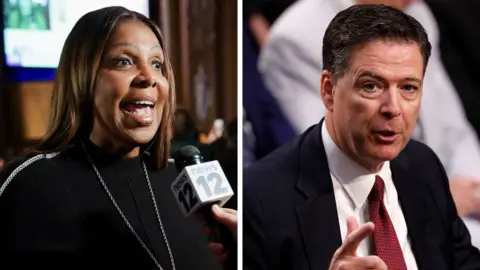
Two high-profile opponents of President Trump obtained major legal victories on the start of the week when a US judge dismissed the government's charges against them.
For weeks following their charges, former FBI Director James Comey and NY AG Letitia James have maintained vehemently that they are not guilty, asserting that the administration and DOJ are merely singling out them for retaliation.
Federal Judge Cameron Currie dismissed the indictments in their cases due to attorney Lindsey Halligan's invalid assignment as US attorney. But she also left the door open for the federal authorities to try again.
- Judge dismisses cases against ex-FBI director Comey and New York AG James
- Federal judge states government 'missteps' may have tainted the Comey trial
- What is ex-FBI director James Comey accused of?
Comey admitted that possibility after the decision, stating he thinks Trump will probably target him again.
And White House spokeswoman Abigail Jackson seemed to confirm it: This will not be the final word on this matter.
But the DOJ faces significant obstacles to effectively try either after this defeat, and experts are reluctant to predict what could occur next due to the cases' unprecedented nature.
It feels to me like unexplored legal ground, said Kay Levine, law professor at Emory University.
Might the justice department appeal?
The DOJ can contest the judge's decision before a higher appeals court. In this case, that would be the Fourth Circuit Court of Appeals.
Attorney General Pam Bondi indicated she would pursue this option, vowing to use all available legal action, including an expedited appeal.
Previously, the former administration has aggressively appealed adverse decisions, taking cases from trial courts and sometimes accelerating its petitions up to the US Supreme Court.
Abbe Lowell, an attorney representing James, pledged to keep fighting any additional politically driven indictments through every lawful means available.
If there is an appeal, the justice department likely would have its own attorneys argue the case, making Halligan's role in the appeals process unclear.
Is it possible there be fresh indictments?
The federal prosecutors charged Comey with lying to Congress and obstructing justice. Government lawyers charged Letitia James with bank fraud and making false statements to a financial institution.
Each pleaded not guilty. In addition to claiming Halligan was unlawfully appointed, both also claimed to be targets of vindictive prosecution.
Since the initial charges were dismissed (though, of course, appeals could change that), the DOJ might try to assemble new grand juries and secure new indictments.
Based on my analysis, a different attorney could bring James' case to a new grand jury and get a fresh indictment, stated Ms Levine.
But John Day, head of the American College of Trial Lawyers, said it could be a complicated path – certainly in the Comey matter.
I can tell you it will be hotly contested, whether Comey's case can be re-indicted if a lawfully appointed prosecutor is appointed and is can obtain an charge.
He described the complex web of lawyers, courts, and legal filings involved as a procedural morass with no easy solutions.
It might be harder for the DOJ to try to bring the exact same charges against Comey.
A key issue is the legal time limit – the time frame that government lawyers had to indict Comey for these specific allegations – which ended at the close of September. Nonetheless, the dismissal of the charges would trigger a six-month grace period for the justice department to refile the case.
Still in that situation, his lawyers said it intends to contend the government is past the deadline.
The ruling also suggests that because the charge is void, the time limit has run and there can be no new indictment, lawyer Patrick Fitzgerald said Monday.
What is the fate of Lindsey Halligan?
In the pair of rulings on the charges against Comey and James, Judge Currie was direct: Halligan's appointment was improper.
Judge Currie wrote in the James decision that the Attorney General's attempt to appoint Halligan as Acting US Attorney for the Eastern District of Virginia was invalid.
Therefore, Halligan had no lawful authority to present the indictment, she wrote.
Federal prosecutors are nominated by the president and require Senate approval. US laws govern how individuals can be assigned on a interim basis, but the judge determined that Halligan's appointment had breached these laws.
That leaves Halligan's role on subsequent cases against James and Comey, once more, unclear.
The ruling also could raise doubts on any other cases Halligan has brought in the Virginia Eastern District where she serves.
But Attorney General Bondi said on that day that she made Halligan a special US attorney and commended her work as outstanding.
The White House maintained its position that Halligan was lawfully appointed, spokesperson Karoline Leavitt told the press on Monday.


